Imagine paddling for a wave, popping up, and riding it to the beach – only to realise later that your back foot was in the wrong place, your head was down, and your pop‑up was slow. You felt something was off, but you could not see it.
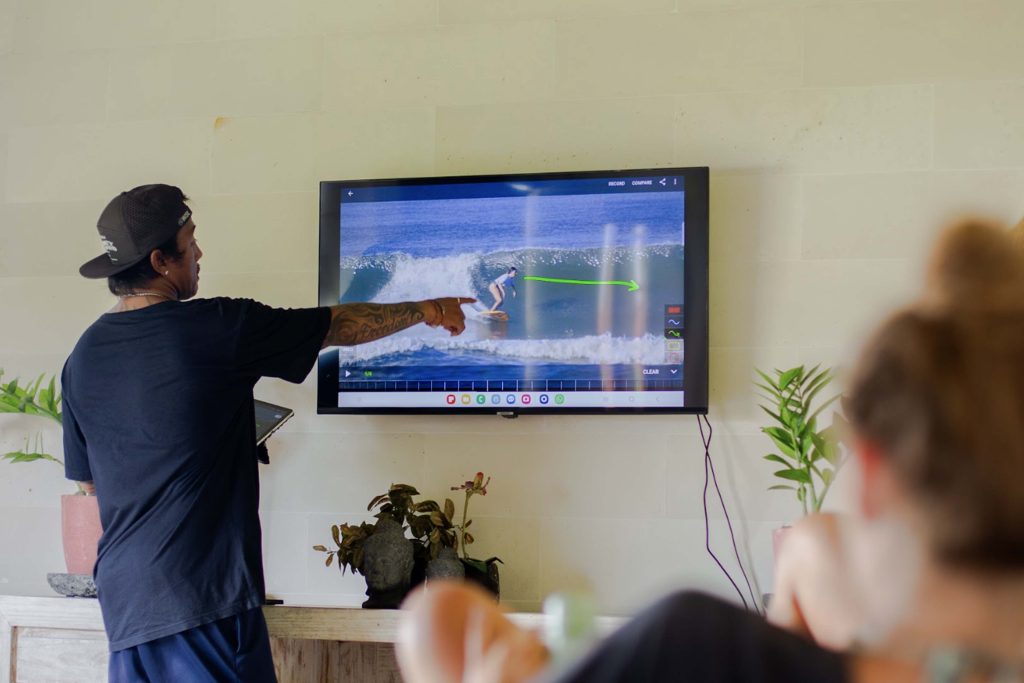
That is why a surf camp Bali with video analysis can be a game changer. Instead of guessing what you are doing wrong, you watch yourself on camera with a coach who pauses, draws on the screen, and shows you exactly what to fix.
But not all surf camps offer the same quality of video analysis. Some simply hand you a phone and say “good luck”. Others turn it into a structured learning tool that doubles your progression speed.
In this guide, you will learn the 5 things to look for when choosing the best surf camp Bali with video analysis. You will also see a clear comparison table, an FAQ section, and internal links to related resources on Soleia Surf.
Why Video Analysis Matters at a Surf Camp
Before we dive into the 5 things to look for, let us quickly understand why video analysis is so effective.
When you are surfing, your brain is busy with a hundred things – reading the wave, balancing, paddling, timing the pop‑up. You have almost no mental bandwidth left to analyse your own posture or movement.
Video analysis solves this problem. It gives you:
- Objective evidence of what you are actually doing (not what you feel you are doing)
- Frame‑by‑frame breakdown of mistakes like a late head turn or staggered hands
- A visual reference that helps you build correct muscle memory faster
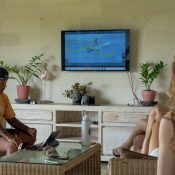
At a high‑quality surf camp Bali with video analysis, you do not just watch the footage alone. A trained coach annotates the video, shows you side‑by‑side comparisons with proper technique, and gives you 2‑3 specific drills to practise immediately.
Now, let us look at the 5 things you must evaluate to find the best camp.
June & July early access — 15% off your stay
No code needed. Applies automatically at checkout. Minimum 4 nights. Surf Holiday and Surf Progression only.
1. Coach-to-Student Ratio During Video Review
Video analysis is not about the camera. It is about the feedback.
Some camps film the whole group together, then play the footage on a big screen without individual attention. You might see yourself for 30 seconds and receive generic advice like “bend your knees more”.
That is not enough.
What to look for:
- Maximum 4 students per coach during analysis sessions
- Personalised frame‑by‑frame review for each student
- Coaches who explain why a mistake happens, not just what the mistake is
Why this matters:
A low coach-to-student ratio means you get 10‑15 minutes of dedicated analysis per session. The coach can zoom in on your specific bad habits, show you dry‑land drills, and check your understanding before you go back in the water.
Without this, video analysis becomes a passive activity – interesting to watch, but not transformative.
2. Structured, Multi‑Session Progression
A single video session is helpful. A structured camp that spans 5‑7 days with daily filming and review is exponentially better.
What to look for:
- A clear progression plan: Day 1 pop‑up, Day 2 stance and balance, Day 3 bottom turns, etc.
- Filming of every surf session, not just the first or last day
- Side‑by‑side comparison of your Day 1 vs Day 5 footage
Comparison Table: One‑Off Lesson vs Multi‑Day Camp with Video Analysis
| Feature | One‑Off Video Lesson | Multi‑Day Surf Camp with Video Analysis |
|---|---|---|
| Number of filmed sessions | 1 | 3-5 |
| Personalised drill plan | Basic | Detailed, evolving daily |
| Progress tracking | None | Side‑by‑side comparison Day 1 vs Day 5 |
| Coach familiarity with your surfing | Low | High – coach learns your habits |
| Typical improvement (pop‑up to green wave) | Minimal | Visible breakthrough by Day 4‑5 |
Choose a camp that offers at least 3-5 video analysis sessions integrated into your coaching. A single review is a taste; a week of daily reviews is a transformation.
3. Quality of the Analysis Tools and Playback
Not all video analysis is equal. Some camps simply hand you an unedited 5‑minute clip on a phone and move on.
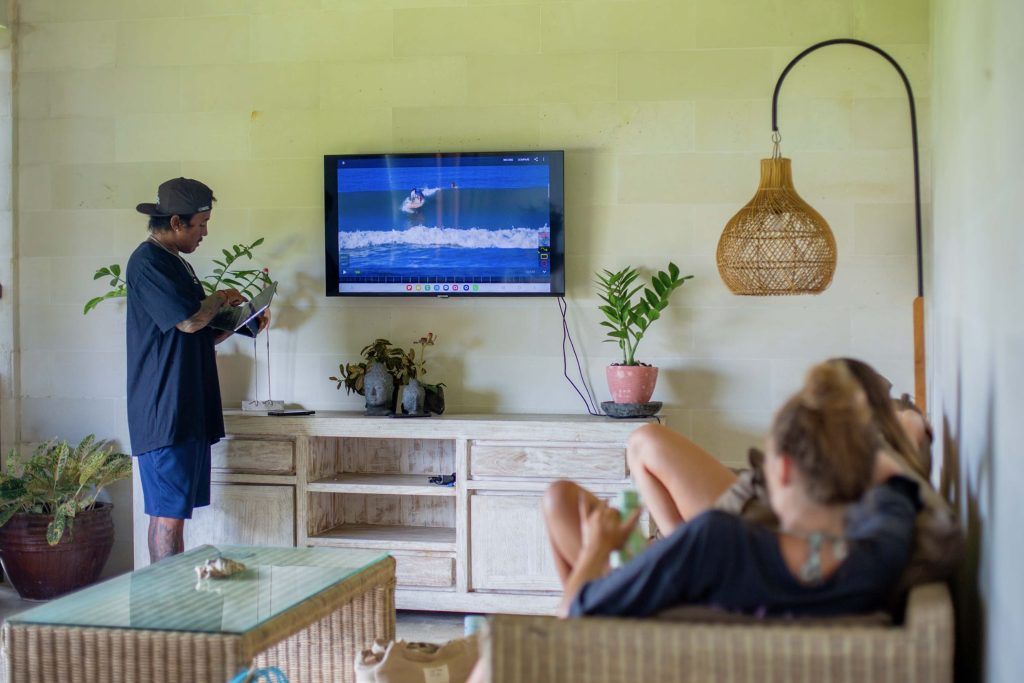
Professional surf camps use software or tablets that allow:
- Slow motion and frame‑by‑frame advance
- Drawing on the screen (lines, circles, angles)
- Side‑by‑side comparison with a pro surfer or correct technique
- Easy sharing of clips to your phone so you can review later
Questions to ask before booking:
- Do you use an app or software for analysis (e.g. Coach’s Eye, OnForm, or similar)?
- Can you draw on the video to show my mistakes?
- Will I receive a copy of my analysed clips to take home?
A surf camp Bali with video analysis that invests in proper tools shows they take progression seriously. If the answer is “we just use a phone and slow motion”, keep looking.
4. Integration of Dry‑Land Drills and Immediate Practice
The best video analysis does not end on the beach. It flows directly into dry‑land drills and then into your next surf session.
What a great camp does:
- After reviewing your video, the coach takes you through 10‑15 minutes of dry‑land drills on the sand
- Drills are specific to your mistakes (e.g. “pop‑up with hands closer together” or “look where you want to go, not at your board”)
- You then paddle out immediately – not the next day – to practise the correction while the feedback is fresh
What a weak camp does:
- Watches video with you, says “try to bend your knees more”, and sends you off
- No structured practice on land
- No follow‑up filming in the same session to check if you improved
The camps that deliver real results combine see (video) + practise (dry land) + do (water) + re‑film – all in the same session. This creates a powerful feedback loop.
5. Bali‑Specific Wave Knowledge and Camera Angles
Bali is not just any surf destination. It has reef breaks, beach breaks, lefts, rights, and waves that change dramatically with the tide and wind.
The best surf camp Bali with video analysis uses Bali‑specific knowledge to get the most out of filming.
What to look for:
- Coaches who know which break works best for filming at different tides (e.g. morning at Batu Bolong for long peeling waves)
- Ability to film from the beach and from the water (waterproof camera or mouth mount)
- Analysis that includes wave selection and positioning – not just your body position
Why this matters:
Poor wave selection means you are fighting the wave instead of practising your technique. A good coach will say: “Skip this wave, wait for the next set – I want you on a shoulder‑high wave with a clean face so we can see your bottom turn clearly.”
This level of detail is what separates a generic surf camp from a truly excellent one.
Summary: Your 5‑Point Checklist
Before you book a surf camp Bali with video analysis, use this checklist:
- Coach‑to‑student ratio during analysis is 1:4 or better
- Camp offers at least 3-5 filmed sessions over 5‑7 days
- They use proper analysis tools (slow motion, drawing, side‑by‑side comparison)
- Dry‑land drills + immediate water practice are included
- Coaches show Bali‑specific wave and angle knowledge
If a camp ticks all five boxes, you have found a place that will dramatically accelerate your surfing.
June & July early access — 15% off your stay
No code needed. Applies automatically at checkout. Minimum 4 nights. Surf Holiday and Surf Progression only.
Ready to Experience Video Analysis at Soleia Surf?
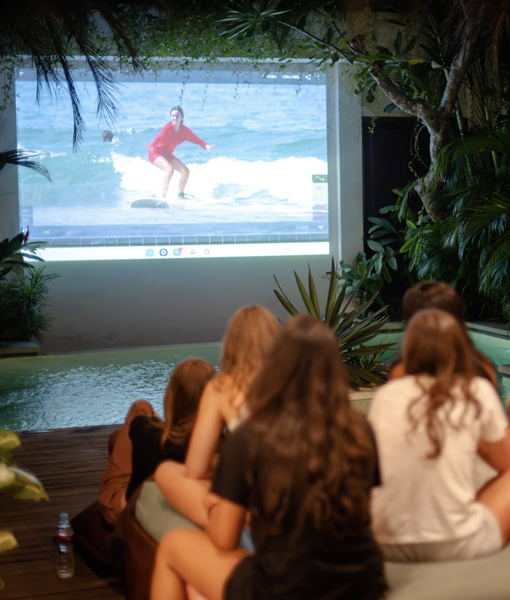
At Soleia Surf Camp Bali, our Surf Progression Package includes daily video analysis as part of every coaching session. We keep groups small, use professional analysis tools, and combine dry‑land drills with immediate water practice.
👉 Book our Surf Progression Package with daily video analysis →
You can also learn more about the science behind video analysis in our complete guide:
➡️ How video analysis surfing works (full guide) →
And if you are still comparing options, read our comparison of Bali surf camps:
➡️ See how Soleia compares to other Bali surf camps →
FAQ: Surf Camp Bali with Video Analysis
Most high‑quality camps film every surf session. For a 5‑day camp, expect 3‑5 filmed sessions – not just one or two.
No. A professional camp provides the camera, tablet, and analysis software. You just surf. Some camps also send you the analysed clips so you can review them later.
Not at all. Beginners benefit the most because they establish correct habits from day one. Fixing a bad pop‑up early is much easier than unlearning it after two years.
Yes. Many camps start with white water waves and film your very first attempts. Seeing yourself on video helps you understand the coach’s instructions much faster.
Almost everyone feels that way at first. But after one session, most students say: “I am glad I saw it – now I finally understand what to fix.” Coaches are trained to be supportive, not critical.
Final Wave
Choosing a surf camp Bali with video analysis is one of the smartest investments you can make in your surfing. You stop guessing. You start seeing. And you improve session by session – not month by month.
Use the 5 things to look for in this guide to evaluate your options. Prioritise small groups, multiple sessions, proper tools, dry‑land drills, and Bali‑specific local knowledge.
Then get ready to watch your surfing transform – one frame at a time.
June & July early access — 15% off your stay
No code needed. Applies automatically at checkout. Minimum 4 nights. Surf Holiday and Surf Progression only.