Whether you’re catching your first whitewater wave or carving along a clean face at Canggu’s Echo Beach, understanding your surf levels is key to improving efficiently — and safely. Knowing where you stand helps you choose the right board, the right waves, and the right surf camp in Bali or anywhere in the world.
At Sōleïa Surf Camp Bali, we meet surfers from every background — from absolute beginners to advanced riders refining their turns. The first step to real progress is knowing your current surf level and what’s next.
This guide breaks down each level clearly so you can identify where you are — and how to keep moving forward.
Why Understanding Your Surf Levels Matters
Before we dive into the breakdown, here’s why it’s so important to know your surf level:
- Faster Progress: Surf coaches can tailor training to your specific needs.
- Safety First: You’ll surf waves that match your ability, reducing risk.
- Better Equipment Choices: Boards and fins make more sense when chosen for your level.
- Right Camp, Right Fit: You’ll avoid overpaying for lessons that are too easy or too advanced.
At Sōleïa Surf Camp Bali, every guest goes through an assessment on day one to determine their surf level and design a personalized coaching plan.
We split our levels in 5:
- L1 Newcomers and Beginners
- L2 Early Improvers
- L3 Intermediates
- L4 Advanced
- L5 Expert
Let's explore each in details.
Read also: Surf Academy Bali vs Self-Learning: Which is Better?
L1 Newcomers and Beginners

You’re eager to catch your first waves and discover why surfing is the most awesome thing you can do.
- Caution: surfing is extremely fun and addictive.
- Surf Line : Straight to the beach
- Goal: Discover surfing safely, stand up for the first time, and build basic water confidence.
Bring your positive attitude to the lineup and enjoy the greatest (and hardest) sport there is!
Core skills to develop at this level
- Board handling and carrying techniques
- Correct lying position and board trim
- Catching broken (whitewater) waves independently
- Pop-up technique (from knees or three-step pop-up)
- Stable surf stance and relaxed balance while riding straight
Physical fitness requirements
- No major strength requirements
- General coordination and mobility
- Comfortable moving through knee- to waist-deep water
- Ability to stay calm, relaxed, and balanced in small waves
Ocean knowledge & mindset
- Understanding how waves break and where to position safely
- Basic surf etiquette and signals
- Learning to feel comfortable in the ocean environment
Requirements to pass to next level
- Catch whitewater waves independently
- Ride for at least 10 seconds with balance and low body tension
- Stand up on most attempts using a controlled pop-up
- Show confidence in knee- to waist-deep water
- Demonstrate curiosity and readiness to learn paddling & positioning
Typical time to reach next level: 5–10 surf sessions with regular practice and comfort in small surf
L2 Early Improvers
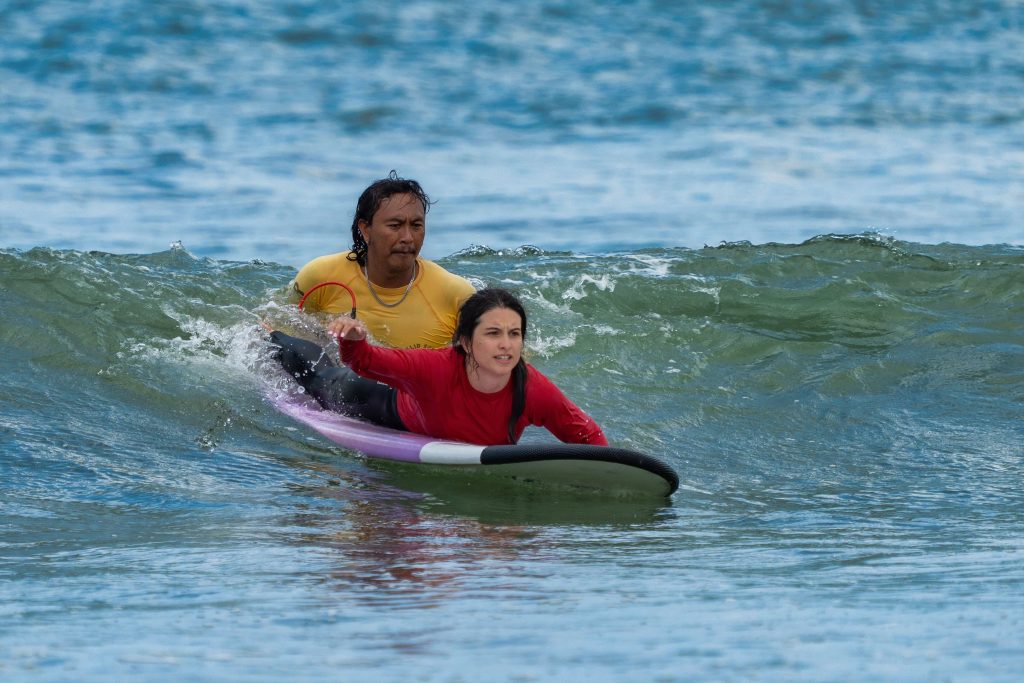
You’re hooked to surfing, and you understand it’s not as easy as it first looked.
Buckle up — serious stuff is about to start.
- Surf Line: Down the line
- Goal: Catch unbroken waves, start trimming along the face, and manage basic positioning and paddling.
Core skills to develop at this level
- Functional surf stance
- Efficient paddling technique (rhythm, long strokes, positioning)
- Angled take-offs both sides
- Basic rail engagement and trimming on small green waves
- Turtle roll to pass whitewash with a larger board
- Kick-out and recovery after the ride
- Reading and selecting small unbroken waves
Physical fitness requirements
- Able to perform several clean push-ups (strong arms and shoulders)
- Core stability and spinal mobility to keep chest lifted while paddling
- Growing upper-body endurance for repeated paddle efforts
- Calm and confident in chest- to head-deep surf
Ocean knowledge & mindset
- Identifying peaks, channels, and safe paddle routes
- Rules of priority and right of way
- Preparing mentally for deeper water and longer sessions
Requirements to pass to next level
- Paddle out to the lineup on their own in 3-4 ft surf
- Catch waves independently, without assistance, on most attempts
- Perform angled take-offs consistently
- Ride waves down the line, both frontside and backside
- Surf with correct surf stance and no tension
- Show commitment and consistency, understanding that L3 progression will require dedicated training and physical preparation
Typical time to reach next level: 20–30 sessions of regular surfing in green waves
L3 Intermediates

Now you’re a real, autonomous surfer. You’ve put in the time and effort — and now comes the juicy part: turning, controlling speed, and building real technique.
It’s also time to get into surfskating to build muscle memory and speed up progression.
- Surf Line: Up and down the wave face
- Goal: Generate speed, link basic maneuvers, and surf with control.
Core skills to develop at this level
- Strong, efficient paddling (endurance and timing)
- Duck diving for shortboards and hybrid boards
- Bottom turns (frontside and backside)
- Basic top turns
- Speed generation (pumping and trimming)
- Reading and adapting to different wave shapes
- Surfskate training for body coordination and rotation
Physical fitness requirements
- Solid paddling endurance (long continuous paddling sets)
- Strong back and shoulders — able to hold “superman” position steadily
- Hip and ankle mobility for deeper surf stance
- Calm underwater and confident with wipeouts
- Basic apnea ability — hold breath comfortably ~10 s after exertion
Ocean knowledge & mindset
- Recognizing power zones and shoulder vs closeout sections
- Efficient positioning in the lineup
- Confidence to recover after wipeouts and longer hold-downs
Requirements to pass to next level
- Bottom-to-top turn combination with control
- Maintain speed through wave sections
- Efficient paddling and duck dives in average surf
- Calm reaction when tumbled underwater
- Completion of basic apnea and breath-control training
Typical time to reach next level: 60–100 sessions, usually 6–12 months of consistent surfing
L4 Advanced

By now, surfing is part of who you are. If you’re here — congratulations — you’re already better than 90 % of surfers out there!
You want to squeeze every ounce of energy from each wave and use the entire face of it.
- Surf Line: Using the full face and returning to the power source
- Goal: Link maneuvers with flow, stay connected to the pocket, and master cutbacks.
Core skills to develop at this level
- Cutbacks (key focus — frontside and backside)
- Deep bottom turns and smooth rail-to-rail transitions
- Linking turns (bottom → cutback → rebound)
- Identifying wave sections (speed, slow, lip, flats)
- Maintaining flow and staying in the power zone
Physical fitness requirements
- Strong, explosive legs (plyometric and balance ability)
- Good squat control and leg endurance
- Breath-hold around 20 s with empty lungs and moderate heart rate
- Lean, flexible, and agile build — cat-like movement
Ocean knowledge & mindset
- Reading wave sections to choose the right maneuver
- Understanding how board shape affects performance
- Planning lines before take-off and adapting mid-ride
Requirements to pass to next level
- Consistent, fluid cutbacks returning to the pocket
- Ability to identify and surf different wave sections intelligently
- Maintains rhythm, speed, and flow throughout rides
- Calm underwater, strong breath control
- Physically lean, mobile, and explosive
Typical time to reach next level: 2–3 years of consistent, mindful practice
L5 Expert

You probably have too many boards in your quiver already, but now it’s time to send some serious spray — and maybe even get barrelled.
- Surf Line: Vertical surfing — nose to the beach → nose to the sky
- Goal: Surf in the critical part of the wave, combining power, precision, and creativity.
Core skills to develop at this level
- Deep, explosive bottom turns
- Top turns, re-entries, and snaps
- Foam climbs and floaters
- Roundhouse cutbacks and swooping carves
- Linking combinations fluidly in the pocket
- Barrel entry and positioning (intro level)
Physical fitness requirements
- Excellent paddle endurance and recovery
- Explosive lower body and dynamic balance
- Strong breath control (20–30 s hold after exertion)
- Mobility and flexibility to adapt to heavy surf
- Full-body control — fluid and responsive, not rigid
Ocean knowledge & mindset
- Advanced wave reading and positioning
- Understanding energy lines and critical zones
- Awareness of competition or performance strategy
Requirements to pass to next level
- Confident in critical surfing — re-entries, floaters, snaps
- Consistent line control under pressure
- Calm and controlled recovery in heavy surf
- Strong paddle power and breath management
- Full technical, physical, and mental surf maturity
Typical time to reach mastery: 3–5 years of steady, focused progression and diverse surf experience
How to Progress to the Next Surf Level
Progress in surfing isn’t just about time spent in the water — it’s about smart practice and consistency.
Here’s how to move up faster:
- Join a structured coaching program (like the Surf Progression or Surf Academy at Sōleïa).
- Surf regularly — at least 4–5 times a week.
- Focus on feedback: Watch your surf videos and identify mistakes.
- Train on land: Balance, paddling drills, and breathwork make a huge difference.
- Surf different spots: Variety builds adaptability and awareness.
Read also: Why Joining a Surf Academy is the Best Decision for Beginner Surfers
Local Insight: Surfing in Bali by Level
Beginner spots:
- Kuta Beach
- Batu Bolong (Canggu)
- Legian
Intermediate spots:
- Berawa (Canggu)
- Medewi
- Nusa Lembongan
Advanced spots:
- Uluwatu
- Padang Padang
- G-Land (East Java surf trip option via Sōleïa)
Bali truly has waves for every Surf Levels — and that’s what makes it one of the best surf destinations in the world.
Read also: 7 Best Bali Surf Spots for Every Level: From Kuta to Uluwatu
Common Mistakes When Identifying Your Surf Level
- Overestimating ability: Leads to frustration and safety risks.
- Choosing the wrong board: Too small or too advanced slows progress.
- Ignoring surf etiquette: Causes tension in the lineup.
- Skipping basics: Strong fundamentals create faster improvement later on.
At Sōleïa, every guest is evaluated individually — ensuring you surf at your true level and progress safely.
Read also: The 5 Biggest Mistakes Slowing Your Surf Progression (And How to Fix Them)
FAQ: Understanding Surf Levels
Usually 3–6 months of consistent surfing (2–3 times a week) under proper guidance.
If you can catch unbroken waves and turn, you might start as intermediate — but an assessment at your surf camp will confirm it.
Join a structured surf coaching program, practice regularly, and review video analysis to correct mistakes early.
Yes — beginner spots like Kuta are safe and sandy, while advanced spots like Uluwatu are for confident surfers only.
When you book, you’ll fill out a quick questionnaire. Upon arrival, our ISA-certified coaches assess your skills to place you in the right program.
Final Thoughts
Surfing is a lifelong journey — not a competition. Knowing your surf level helps you enjoy every session, stay safe, and keep progressing with confidence.
Whether you’re learning your first pop-up or improving your bottom turns, Sōleïa Surf Camp Bali has the right coaching program and community to guide you.
From beginners catching whitewater at Batu Bolong to intermediates refining their turns or advanced surfers joining our Java Surf Safari, every surfer has a place at Sōleïa.
Start where you are — and let your next wave take you to the next Surf Levels.